From April 1, India’s six-decade-old tax law, the Income-tax Act, 1961, will give way to the Income-tax Act, 2025.
The government says this is not just a tax overhaul, but a law rewrite. Tax rates stay the same. Your income tax slabs don’t change. What changes is how income, deductions, salary, capital gains and disclosures are reported, verified and filed.
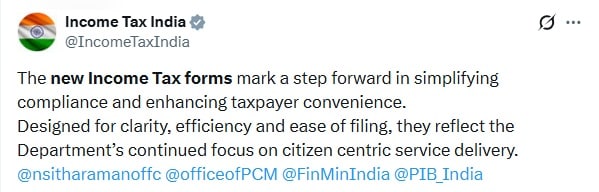
This is less about paying more tax and more about reporting tax far more precisely, according to the government.
Meal Card
Salaried employees who receive meal coupons, vouchers or cards such as Sodexo, Pluxee and Zaggle, or who use subsidised office canteens, stand to gain a significantly higher tax break under the new rules approved last week.
Under the Income Tax Rules, 2026, the exemption limit for employer-provided meals has been raised from Rs 50 per meal to Rs 200 per meal. This benefit is available under both the old and the new tax regimes.
Earlier, if an employer provided two meals worth Rs 50 each in a day, only Rs 100 qualified for exemption. With the revised ceiling, up to Rs 400 per day can now be tax-exempt.
Over a typical working month, this translates into a meaningful annual benefit:
- Rs 200 × 2 meals = Rs 400 per day
- Rs 400 × 22 working days = Rs 8,800 per month
- Rs 8,800 × 12 months = Rs 1,05,600 per year
In effect, employees can now claim over Rs 1 lakh a year as tax-exempt through meal benefits alone, provided the employer structures the benefit accordingly.
HRA Rules
The new rules also retain and expand the framework for House Rent Allowance (HRA) claims.
The higher 50 per cent HRA exemption category, which earlier applied only to Mumbai, Kolkata, Delhi and Chennai, has now been extended to Bengaluru, Hyderabad, Pune and Ahmedabad. All other cities will continue under the 40 per cent HRA bracket.
However, claiming HRA will now require stricter disclosure. Salaried employees must furnish landlord details in a separate declaration, Form 124, at the time of income computation and TDS deduction by employers. This effectively makes it mandatory to disclose the landlord’s identity while claiming HRA, tightening checks on inflated or fictitious rent claims.
What Actually Changes From April 1
| Area | What changes | What it means for you |
| ITR-1 / ITR-4 | Eligibility expanded (up to 2 houses) | More people can use simpler forms |
| Tax law structure | 819 sections shrink to 536, language simplified | Easier to read, fewer cross-references |
| Terminology | “Financial Year” & “Assessment Year” replaced by Tax Year | Less confusion while filing |
| ITR forms | Completely redesigned | More detailed reporting of income & assets |
| Form 16 | Replaced by Form 130 | Salary tax reporting becomes system-driven |
| Filing process | Heavily pre-filled, auto-validated | Errors/mismatches flagged faster |
| PAN usage | PAN needed in more transactions | Higher reporting & tracking of spends |
| Capital gains | Clearer rules for holding period, valuation | Investors must report more carefully |
| Old vs New regime | Option exercised inside ITR | No separate form needed |
| HRA rules | More cities at 50% exemption, landlord relation disclosure | Fake rent claims harder |
| Perquisites | Limits revised after decades | Salary structuring may change |
Income-tax Act, 2025: Form 16 Is Gone
From April 1, employers will no longer issue Form 16. It will be replaced by Form 130.
| Form 16 (old) | Form 130 (new) |
| Employer-generated | Downloaded from TRACES portal |
| Basic salary & TDS data | Detailed salary, deductions, tax computation |
| Scope for mismatch | System-validated with TDS filings |
| For salaried mostly | Also for pensioners, senior citizens (interest income) |
| Manual format possible | Cannot be generated manually |
Why This Matters
Your ITR (income tax return) will now rely on exact system data. If your employer’s TDS filing has an error, your ITR and refund can get delayed. Therefore, ITR forms will feel very different
Here’s what to expect:-
- Clear break-up of salary, deductions
- Separate reporting of short-term vs long-term capital gains
- Asset disclosures in complex cases
- Defined method for asset valuation and holding period
- Heavier data for investors, NRIs, high earners
- Better pre-filled returns for salaried individuals
Impact On Categories
| Category | Impact |
| Salaried employees | Form 130, perquisite changes, HRA rules |
| Investors & traders | Detailed capital gains reporting |
| High-income individuals | Additional disclosures |
| NRIs | Cross-border asset reporting |
| Senior citizens | Integrated pension + interest reporting |
| Employers | Salary restructuring, payroll changes |
Perquisites & Salary Structure Changes
Some draft rule tweaks may increase or decrease tax outgo depending on your salary structure.
| Provision | What’s new | Impact |
| HRA exemption | 8 cities now eligible for 50% rule | Higher exemption possible |
| HRA disclosure | Tenant-landlord relationship mandatory | Fake claims difficult |
| Perquisite limits | Revised after decades | Some benefits more tax-friendly |
| Car perquisite value | Increased | Slightly higher tax for car benefit |
| Transport allowances | Impacts even new regime users | Salary planning needed |
Experts say many salaried people may now find the old regime more beneficial, but only after calculation.
PAN Rules Tighten
PAN will now be required in more transactions, including car purchase/sale and other high-value spends. Reporting becomes tighter, but low-value reporting reduces.
Also, another notable change is how an individual chooses tax regime. Earlier, there were separate form to opt for new regime. Now, people just choose inside the ITR. Besides, refunds will be faster for accurate filers, and slower in cases of a mismatch.
Additionally, you can now use these simpler forms even if you own up to two houses, subject to conditions.
What Stays The Same
- Tax slabs
- Tax rates
- No new taxes
- All past rights, liabilities remain valid
- The bigger goal of the new law
The new Act focuses on:
- Faceless assessments
- Digital compliance
- Less human interface
- Lower litigation
- Global-standard tax drafting
It also formally defines digital space (email, cloud, smartphone) for search provisions.
Important timeline clarity
- Law effective: April 1, 2026 (FY27)
- First ITR under new law: Filed in 2027
- But compliances (salary, TDS, forms, PAN usage) start immediately
- One more layer: Labour Codes impact salary too
Alongside tax changes, Labour Codes (effective Nov 21, 2025) require wages to be at least 50 per cent of total pay, forcing companies to rethink salary structures. This may impact take-home pay and tax planning.
What You Should Do Before April
- Recalculate old vs new regime benefit
- Review salary structure with HR
- Ensure landlord details are genuine for HRA
- Track capital gains documentation carefully
- Check PAN linkage in investments and purchases
- Verify TDS accuracy with employer quarterly